
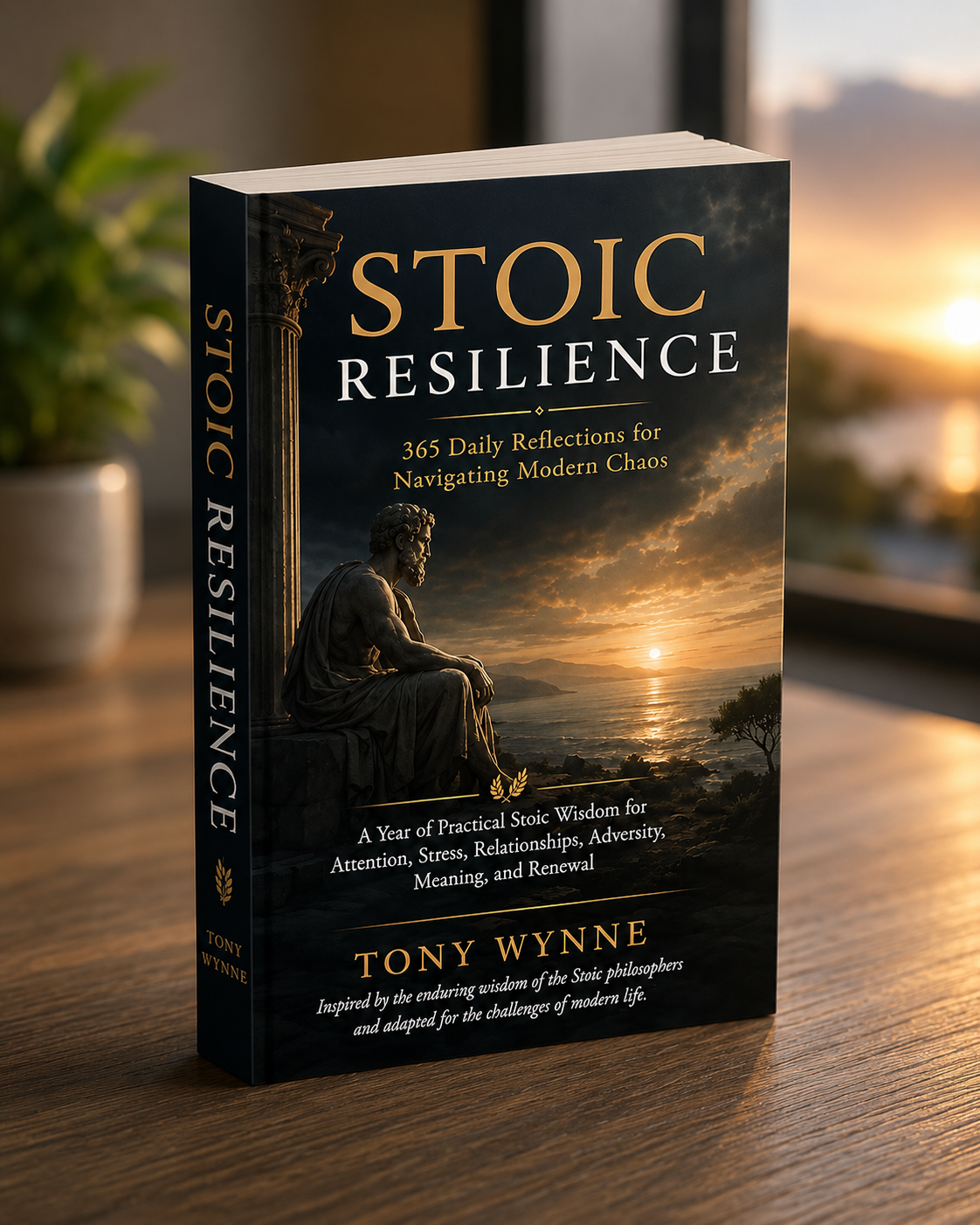
Stoic Resilience
365 Daily Reflections for Navigating Modern Chaos
A practical year-long guide to meeting uncertainty, disruption, and everyday pressure with clarity and perspective.
Paperback • 427 pages
What It’s About
Stoic Resilience offers a year of daily reflections for readers trying to remain grounded in a world that rarely slows down. Drawing on Stoic ideas without turning them into slogans, it explores how ancient principles can help us respond to modern uncertainty, distraction, pressure, and change.
Each entry focuses on one practical question: what is within your control, where your judgment may be working against you, and how you can meet the day with greater attention and steadiness. The reflections are brief enough for a daily practice, but substantial enough to return to when circumstances shift.
This is a book about resilience as a discipline rather than a personality trait. It does not promise control over what happens next. It offers a way to think more clearly about your choices, your reactions, and the kind of person you want to be, even as life remains unpredictable.
Read a Sample
From the Preface
I did not write this book because I have mastered resilience.
I wrote it because, like many people, I have experienced periods of stress, uncertainty, distraction, and overwhelm. I have watched how easily modern life can pull our attention away from what matters most. I have also discovered that wisdom, perspective, and peace are rarely found through bigger solutions. More often, they emerge through small daily practices repeated over time.
The Stoic philosophers understood something that remains true today: while we cannot control everything that happens to us, we can influence how we respond. That simple idea has the power to transform how we experience both ordinary days and extraordinary challenges.
January 1
Pause Before You Check
Many people begin the day the same way. Before their feet touch the floor, they reach for their phone. A quick glance turns into email, headlines, social media, weather, messages, and notifications. Within minutes, other people’s priorities enter the room.
The problem is not the phone itself. The problem is that your attention gets handed away before you have chosen where it belongs. The first moments of the day often shape the tone of everything that follows. If your morning begins with urgency, comparison, or worry, those feelings can linger long after you put down your device.
The Stoics believed that our attention is one of our most valuable resources. They taught that while we cannot control everything that happens around us, we can choose how we respond. The moment you wake up, you still have that choice. You do not have to surrender it to a screen immediately.
A few minutes may not seem important. Yet those first minutes are among the few moments each day that belong entirely to you. Before the demands of work, family, news, and technology arrive, you have an opportunity to begin from a place of intention rather than reaction.
Today, remember that your attention is something you direct, not something that should be claimed by whoever reaches it first.
Practice: Leave your phone untouched for the first five minutes after waking. Notice how it feels to begin the day with your own thoughts before anyone else’s.