
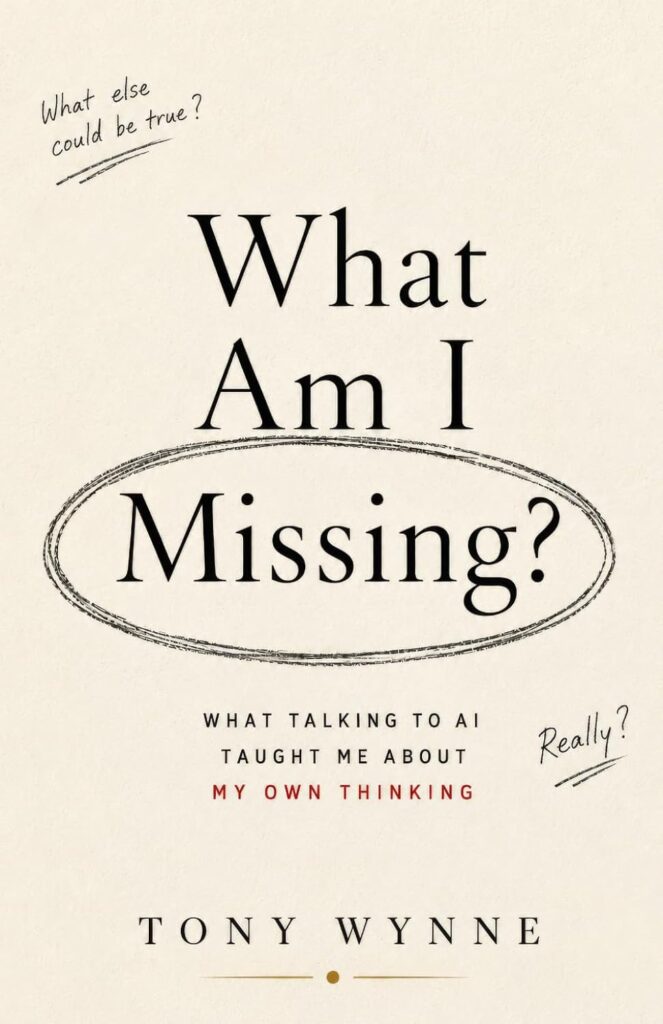
The title is a question, and it stays one.
Tony Wynne began using AI to save time. What came back was fluent, professional, and quietly wrong. Not wrong in obvious ways. The drafts were clean, the summaries competent, the answers sensible. But something kept going missing, and the closer he looked, the more the explanation pointed back at him. Sometimes the problem was not the machine. It was the question he had asked, and the assumptions sitting behind it that he had carried for years without ever having to say out loud.
This is a reflective, conversational book rather than a technical one. It works through ordinary situations: a contract nobody could summarize, a policy announcement that sounded fine and satisfied no one, a meeting where the leader invited disagreement and the room stayed silent. In each case, what was absent mattered more than what was produced. Eventually the same scrutiny turned on the manuscript itself, which had become suspiciously tidy.
It will be useful to leaders, managers, writers, and anyone whose work involves deciding what a situation actually means before acting on it, whether or not they use AI at all.
Readers will likely finish it noticing something they did not notice before: how quickly certainty forms, how much of it rests on habit, and how much changes when a question is allowed to stay open a little longer.