
People sometimes ask how a piece starts, and I think the expected answer has something to do with melody or manuscript. A phrase shows up, you follow it, score it, and eventually there’s a song. That does happen. It just isn’t usually how it goes for me.
Most of the time, it starts with noticing something.
Feeling first, notes later
I spend a lot of time observing. How people move through situations, what they say, what they don’t. Almost none of it turns into music. But every now and then, something stays with me, and I find myself coming back to it over weeks or months without really deciding to.
I’ve learned to let that stage take its time. When I go to the piano too early, I tend to write something that sounds like other things I’ve already written. Sitting with the feeling a little longer usually helps, even when I’d rather be making progress.
So the earliest work isn’t at the keyboard. It’s trying to understand what I’m reaching for, and whether there’s a way to say it without saying it.
Starting with the piano
When I do sit down, the piano comes first, and I try to make sure it can stand on its own.
Whatever the finished piece turns into, the piano version needs to work by itself from beginning to end with nothing else in the room. If it doesn’t, I know the foundation isn’t done yet. It’s easy to add instruments and mistake the improvement for the piece getting better, when really it’s just getting fuller. Anything layered on afterward should add to something that already works.
There’s another idea I keep returning to, and it’s harder to put into words. I’d like my music to be heard more than listened to. I’m not trying to hold anyone’s attention or point out what they should be feeling. If someone has a piece of mine on while they’re working or driving or thinking about something else, and something in it reaches them anyway, that’s what I’m after.
It’s a difficult thing to aim for. It rules out a lot of the more obvious approaches, and I don’t always get there.
Which brings me to “Parallels”
There’s a piece on the piano right now called “Parallels.” It isn’t finished, and honestly, it’s in very early development. But I’ve been living with it long enough that it feels real.
Here’s where it came from.
Conflict is everywhere, and it’s rarely as simple as it appears. There are usually two sides, often more. What I’ve come to believe, more as I’ve gotten older, is that I can’t form a well-informed opinion until I understand all sides. Not my own versions of the other side, but the actual ones.
That takes longer than having an opinion right away. It’s the approach that makes the most sense to me, though I won’t pretend I always manage it.
“Parallels” is my attempt to hear that rather than explain it.
The shape of it
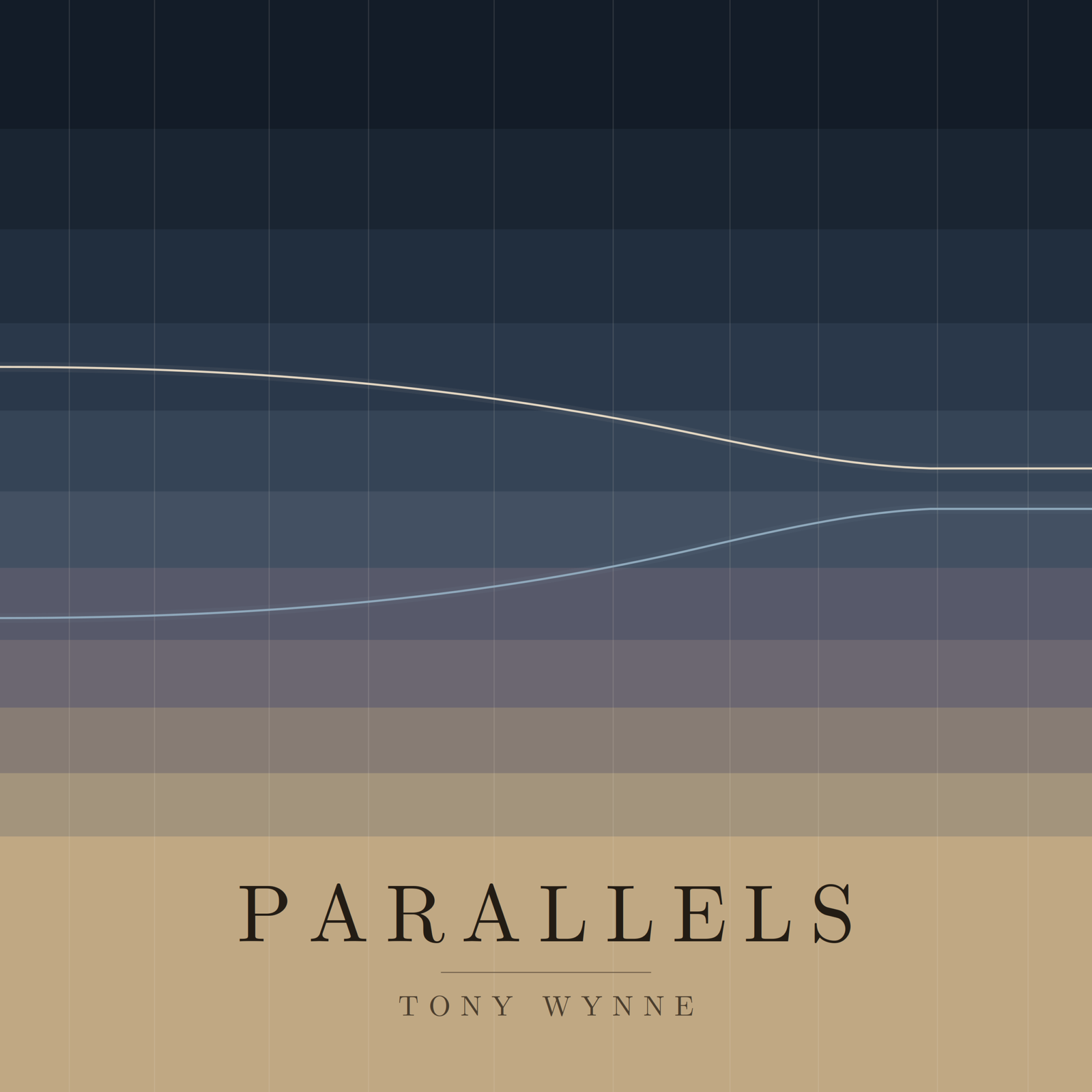
The piece is built around two distinct voices. They shadow each other throughout, moving alongside one another and occasionally meeting and agreeing harmonically before continuing on their own paths. There’s some tension between them throughout. Toward the end, they resolve.
Neither voice is meant to come out ahead. They should carry equal weight, and I’m trying to keep the writing balanced enough that neither one reads as the main one.
I’m also not assigning identities to them. They aren’t two people, two versions of me, or any specific pair of positions. Whatever a listener wants to hear in them is fine by me, and that openness is part of the idea. Harmonically, it sits in open, free-flowing territory.
Where it stands
I’m still in the piano stage, and I expect to be there for a while. Once the foundation is solid, I’ll have a better sense of which instruments should carry the two voices. It seems early to guess at that before there’s something for them to support. The cover art is already done, which is a little out of sequence. Seeing the idea sitting still sometimes helps me hear what’s missing.
More when there’s more.
Tony